
Tuesday, February 20, 2018
Omar Suleiman Tweets on "Women of the Nation"
This totally made my day! Popular Muslim preacher, scholar, and Black Lives Matter activist Omar Suleiman tweets that he is thoroughly enjoying Women of the Nation! Alhamdulillah!


Sunday, February 18, 2018
Ziyarah Through an African American Muslim Woman’s Eyes, Traveling Full Circle - Atlanta, Detroit, Senegal

Love led me to this path. The sublime thing that stirs love in the
heart, we call beauty. Beauty, then, is what brought me here.
Perhaps I owe it to the beloved souls that taught me my first
lessons in beauty. “Black is beautiful!” my father protested. “Jamillah means
beautiful on the inside,” my mother insisted, never once claiming to be an
Arabic scholar.
The goal of the path, Tariqah Tijaniyyah in my case, is nothing
other than Allah. And since we come from Allah to return to Allah, the earthly
journey to the path indeed begins with our first teachers: our parents.
My parents came to Islam from the Nation of Islam when they
followed Imam W.D. Mohammed (R) into mainstream Islam in 1975. I was born a
year later.
Fast forward 39 years later to 2015. With shining pink dhikr
beads, I am sitting in the Tijani masjid, or zawiya (the Sufi term for a place
of spiritual retreat), in my hometown of Atlanta. The state of my heart has
driven me here. The great Sufi poet and scholar Rumi captures my heart’s condition
precisely, “The lightning of love for the beloved has shot into this heart.”
I had learned through my studies both at Duke and Zaytuna that the
Sufi scholars were the masters of the heart. When we seek to purify our hearts,
to make them beautiful, and to fill them with the love of God, we are pursuing
the level of devotion described as ihsan, beauty. Only with teachers and loving
companions can one excel in this path.
When Allah favored me with the ardent desire for this path, I
turned to women for guidance—various women with teachers from several different
turuq (paths) and ethnic backgrounds. Ultimately, there is no explanation for
why I chose this tariqah. Allah chooses.
I believe, however, that growing up in the W.D. Mohammed community
greatly influenced my attraction to this tariqah. Beauty is in the eye of the
beholder, and I found this path beautiful because of how my eye, my heart, and
even my ear had been groomed in my home community.
Because of my religious roots, I easily embraced that it was a
Black African who brought the great Tijani fayda, or flood, that Shaykh Ahmad
al-Tijani, from Algeria, predicted. Thanks to Imam W.D. Mohammed, I had not
been brainwashed to believe that only Arabs and Persians could be the greatest
scholars and saints of all time.
Even the rhythm of the dhikr resonated with me because I was
nurtured to value Africa’s cultures and to believe that they adorned Islamic
practice, not tainted it. And finally, but probably most importantly, the
sisters and brothers in the zawiya made me feel at home, many of whom I already
knew from my local WDM masjid community.
Ziyarah, a universal practice
The connections between my new Sufi community and my home
community continued to emerge. I had been in the tariqah now for six months. My dear friend Sumayya called to see if I was available to speak at the Shaykh Hassan
Cisse Ziyarah to be held in December 2016 in Detroit. “Shaykh Mahy will be
there, and like every Tijani in the country,” she said convincingly.
I imagined that the Ziyarah, Arabic for a “visit” or “visitation,” would be similar to a childhood ritual that I describe in my book American Muslim Women. “Whenever Imam W. D. Mohammed visited a city, his followers would flock there from all the nearby regions to hear him speak.” This ritual included “dressing in your finest clothes” and “seeing all the faces in your community.”
It is no surprise that the concept of ziyarah would emerge as a
common thread because the practice of visiting the blessed is universal.
Ziyarah, or visiting sacred places and people, living or dead, was a widespread
practice in pre-modern societies, among both Muslims and Christians, Sufis and
non-Sufis.
Ziyarah continues to be a common practice across various Muslim
cultures in various shapes and forms. As Hajja Ayisha Jeffries Cisse noted,
“For the Sufi, it can be a visit through our worship or in our memories. The Ziyarah of Imam Shaykh Hassan Aliou Cisse (R) in
America is a sacred journey of our Spirit to his memory and his legacy.”
Indeed, the universal practice of ziyarah has taken on an
expression unique to African American Muslims through the Annual Shaykh Hassan
Cisse Ziyarah, which first took place in December 2010. Nasrul Ilm America has
organized the Ziyarah annually to commemorate the life of Shaykh Hassan Cisse,
the preeminent spokesperson of the Tariqah Tijaniyyah before his passing in
2008.
Shaykh Hassan (R) was a consummate Islamic scholar and guide,
emerging from a long and vibrant legacy of learning in West Africa. He was the
first grandson and spiritual heir of Shaykh Al-Islam, Al-Hajj Ibrahim Niasse,
who led the largest single Muslim movement in twentieth-century West Africa.
The annual Ziyarah functions as an opportunity to visit with
Shaykh Hassan by celebrating his legacy, to visit with Shaykh Mahy Cisse, his
youngest brother and spiritual heir (may Allah bless and preserve him), and to
visit with other murids (students of a shaykh). In his speech at the 2007
International Tijaniyyah Conference in Fes, Shaykh Hassan emphasized fellowship
as a central component of Ziyarah:
“In the spiritual path, the meeting of the brothers and sisters is
more important, even than making the awrad, the remembrance of Allah. Because
of what? The dhikr, if you miss it, you can make it up another time. But the
meeting with your brother or sister, if you miss it, that’s it--you missed it,
finished! You cannot make it up. You cannot bring these people back.”
Similarly, Shaykh Mahy Cisse has described the Ziyarah as the
gathering of lovers. “We make Ziyarah to show our love for our shaykh.” He
shared the following at the 2016 Ziyarah in Detroit:
“Allah loves Ziyarah. The Prophet (S) said, ‘A man was traveling
to a village to see a brother. An angel appeared to him in the form of a human
being and asked him, “Where are you going?” He said, “I am going to this
village to see such and such.” He said, “Do you have business with him?” He
said, “No, I just love him for the sake of Allah.” The angel told him, “Allah
sent me to tell you that He loves you because you love your brother.”’
“Everybody here can have it [the divine love rewarding brotherly
love] because everyone came here for the sake of love, and that love is for
Allah, tabarakah wa ta’ala (T).
“The real mashayik, if you love them, but they know this love is
not for Allah (T), they don’t love that. They love to see people love them for
the sake of Allah. If you love them for the sake of Allah, you will follow in
their footsteps, [which] is to follow the way of Rasul Allah (S), and your
ending will be their ending….This is the real love.”
The Detroit Ziyarah
I traveled alone to Detroit. I had never met Malia, the sister
hosting me, but when she picked me up, she immediately remembered me. “I was at
the lecture you gave at Howard.” I’ve experienced this again and again in the
path: the realization that other murids and I have already crossed paths.
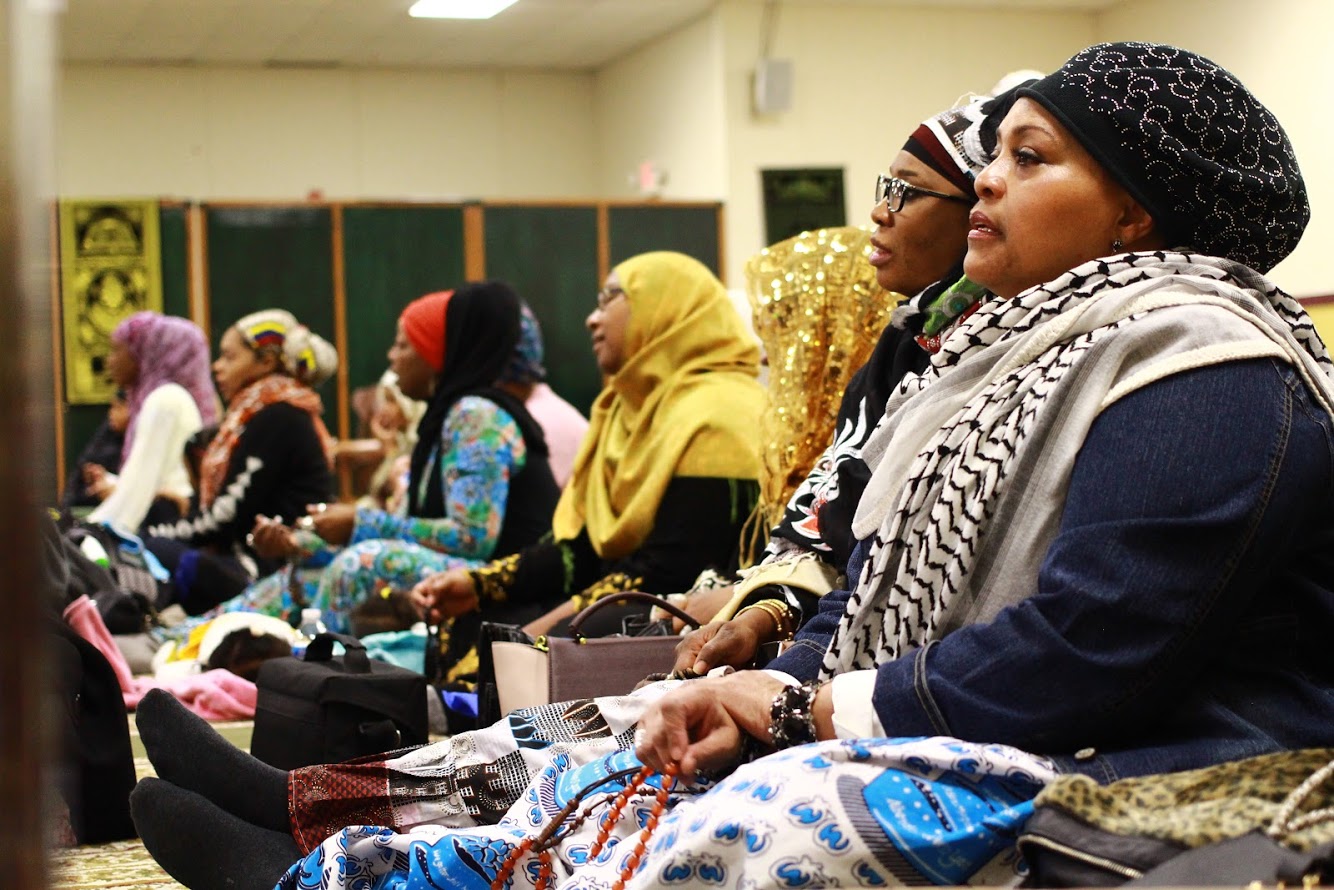
I anxiously hoped we would make it in time for dhikrul jumu’ah and
wazifah. Murids eagerly anticipate Ziyarah as a time to perform our awrad
(litanies) in the company of our shaykh.
 |
| Photo Credit: ThirdEyeLenz |
My anxiousness was amplified by the fact that I was new to the
Tijani community. And, I admit, I couldn’t help but think about the fact that I
was now in one of those “other” Black Muslim communities. It’s no secret that
Muslims outside the WDM community have made judgements about our imam and
community. And from our side, we’ve held our own set of assumptions and
stereotypes about other groups.
But as Malia and I bonded on the drive that seemed like forever,
those false walls were falling inside. And then came the moment when I knew the
whole thing was divine. We arrived at the masjid for dhikrul jumu’ah, and it
was the Muslim Center, a mosque community that identifies with the leadership
of Imam W.D. Mohammed!
The sign above the door was adorned with the emblem that signaled
home for me, a red Qur’an with the pages spread open to appear as wings, held
up by the words in Arabic, “There is none worthy of worship but God, and
Muhammad (S) is the Messenger of God.”
This is the emblem that Imam Mohammed chose for the community’s
newspaper to signal the change in direction. And again the connections flooded
in. Detroit is where the Nation of Islam started. The Muslim Center evolved out
of Temple #1, the first Nation mosque. The Muslim Center demonstrates radical
growth, love, and unity as it warmly opens its doors to the Tijanis (and other
Sufi communities). It mirrored the radical flow of love and serenity in my
heart. Just when I nervously opened myself to a new community, Allah made
everything feel like home.
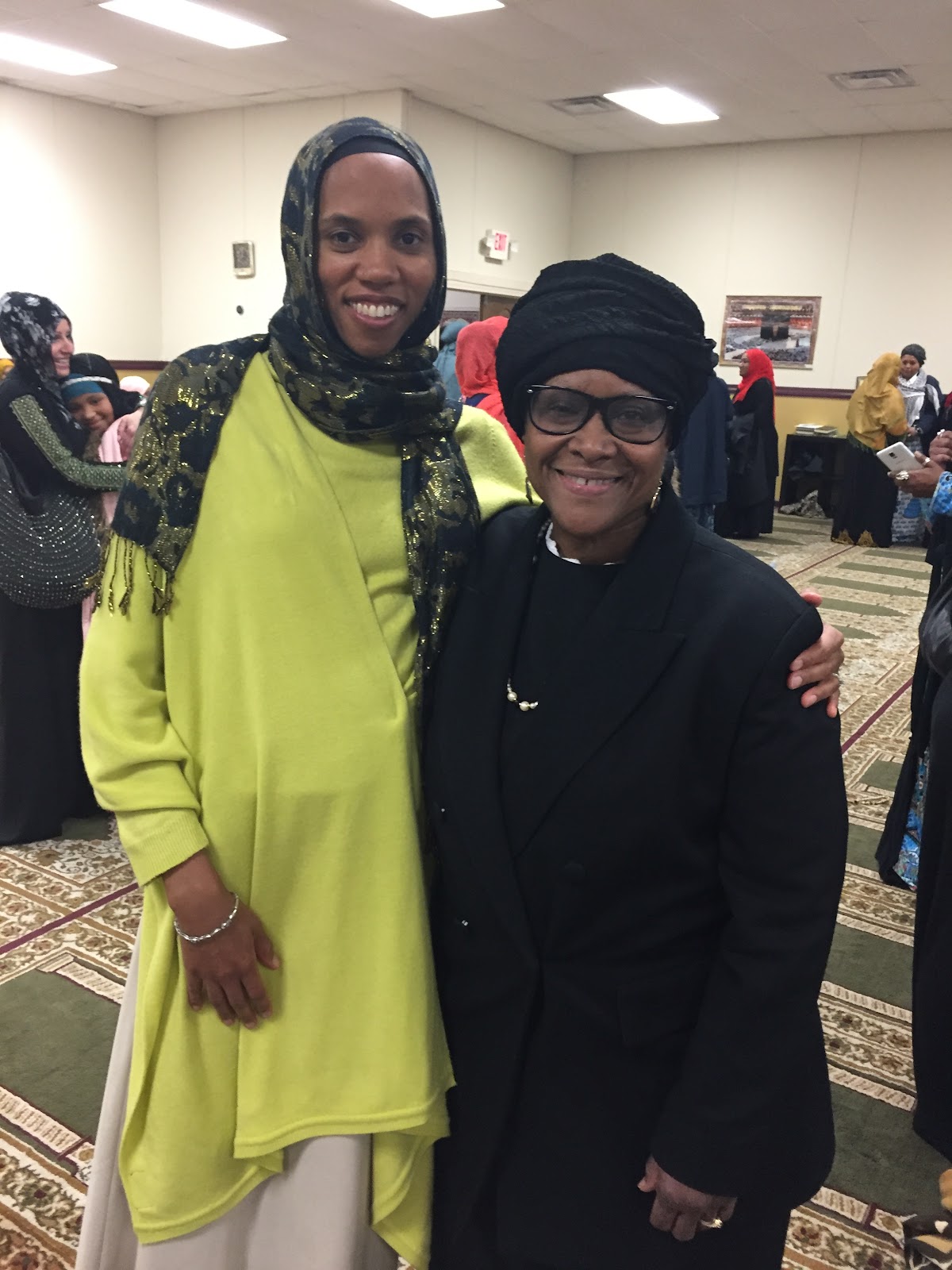
Now inside the Muslim Center, the multiple conversations around the
prayer space, the laughter, and the embraces indicated that we had missed the
dhikr. Smiles greeted me from both new and familiar faces, followed by
heartfilled hugs. After praying ‘Isha, the conversation turned to visiting
Shaykh Mahy.
It was between 8 and 10 pm when we arrived at the house where
Shaykh was staying. It was bustling with men and women. The first familiar face
was a brother I grew up with in Atlanta. We exchanged words, and then Malia and
I were immediately directed to the room where Shaykh greeted visitors.
And of course, another connection was made, this time related to
gender. Sitting around Shaykh, the women outnumbered the men. Within arms reach
of Shaykh, women remained in his proximity even after they greeted him. I, in
turn, greeted him and asked two questions. He answered them, and made dua for
Allah’s ease for me in the path.
 |
| Photo Credit: ThirdEyeLenz |
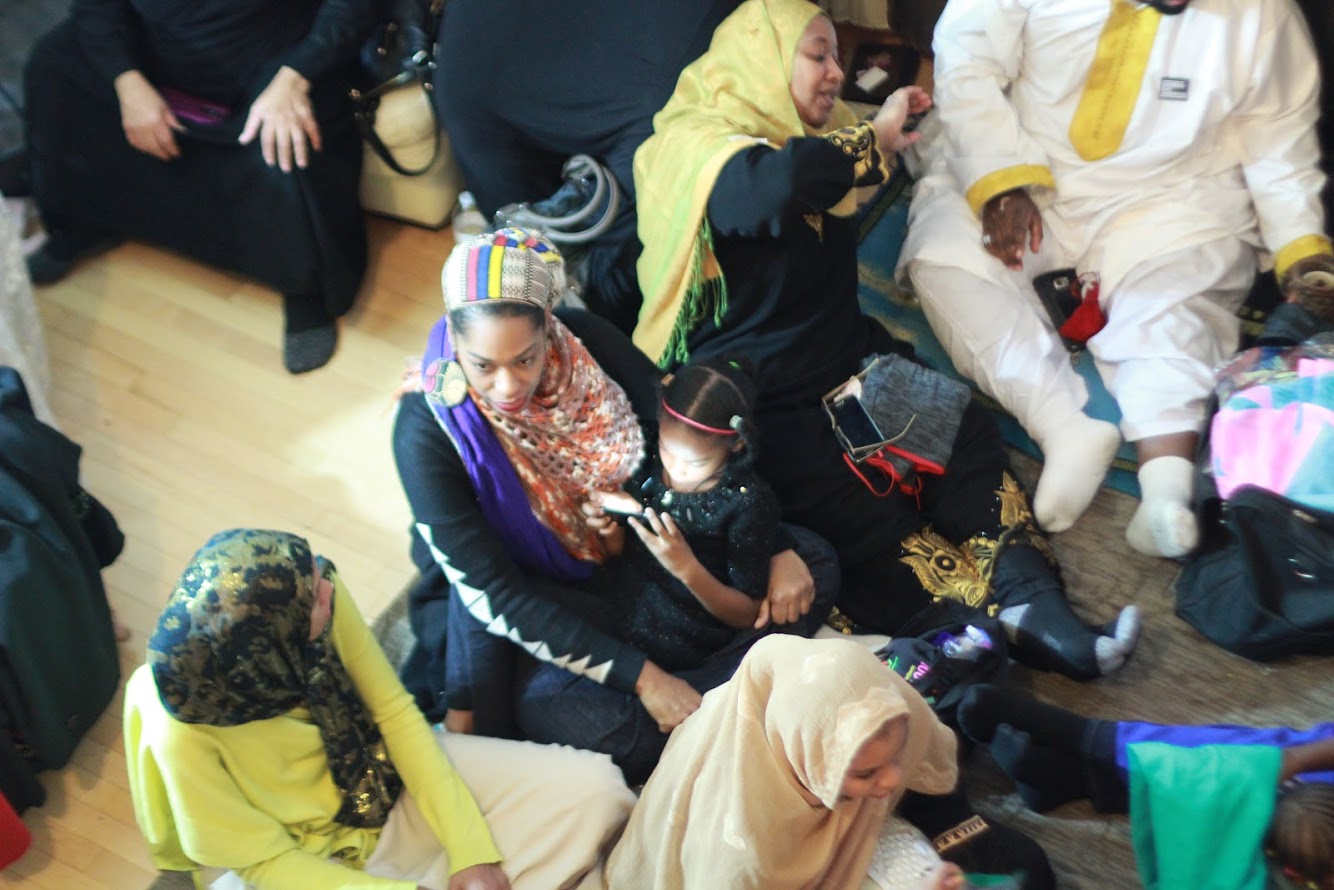
The gender interaction in the space certainly sustained my sense
that I had left home only to return. Sure, there were gender boundaries but
also signs that the boundaries were soft and flexible. A brother, for example,
selling dresses and scarves from Senegal, sat comfortably among the women, his
customers. A wife sitting with her husband in the midst of brothers, for they
were her brothers too. This movement across gender lines indicated that women
were valued and their voices were fairly heard, what I had been accustomed to
in my home community.
Commemoration Night: Shaykh Mahy Cisse and Shaykh Abdul Karim
Yahya
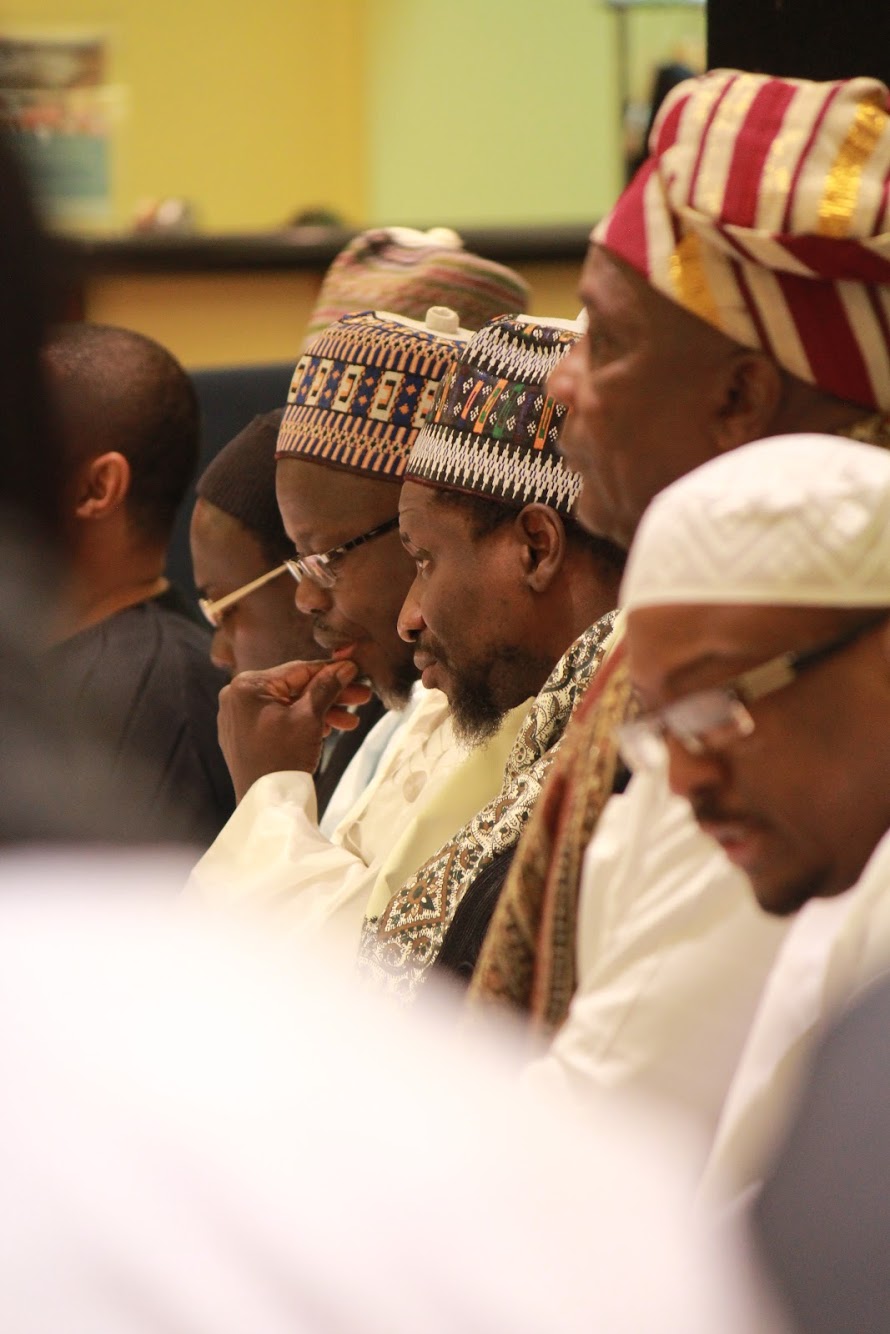
The commemoration program was filled with speeches on the legacy
of Shaykh Hassan (R), dhikr, poetry of praise on the Prophet (S), and
recognition of community members’ work and service. The stellar choice of
speakers made the night exceptionally memorable; however, there were two talks that
especially stood out to me as a new murid still internalizing Sufi concepts and
practices.
The first talk was by Shaykh Abdul Karim Yahya. He gave an
excellent explanation of why we seek a shaykh as part of the prophetic
tradition. This practice stands upon the concept of seeking “our opening
through those who have seen the one we did not see.”
This concept is grounded in a hadith in Bukhari and Muslim that
ends, “A time will come where a people will go forth [fighting], and they will
say, ‘Is there anyone among you who saw someone who kept the company of someone
who kept the company of Allah’s messenger (S)?’ And it will be said, ‘Yes,’ and
so their opening will be granted.”
What Shayky Abdul Karim imparted was that “those who see those who
saw those who preceded them, it is as if they saw them or they gained that
opening and that benefit.” This is the concept of asanid, chains of connection
going back to the Prophet Muhammad (S).
Shaykh Abdul Karim continued with gracious recognition of the
light and beauty he saw in our teachers:
“It’s not adab to mention one’s tariqah in the company of other
turuq, but I’ll just say that Allah privileged me to study in the city with a
group of the prophetic family that’s known as the highest concentration of ahl
bayt on this earth and gaze at them and their way.
“And then we met the likes of Imam Joseph, and we saw here what we
saw there. And in his sons, we saw here what we saw there. And when we had the
opportunity to make hajj with Shaykh Mahy, we saw what we heard in the
biographies of like twelfth-century imams that this great imam--you will have a
legal question and you’d be looking for him. Go among the common people and you
will find him!
“We made hajj with Shaykh Mahy, and he doesn’t want me to say
this, but understand those from whom you are taking [because otherwise you may
not realize his station because of Shaykh’s practice to sit with the common
people]. On the hajj, he was an obscurity just lying among the African
brothers.
“These asanid take us back to Allah’s Messenger (S). Imam Salim
Joseph alluded to this when he spoke, and Shaykh Mahy will not mind me saying
this. See in Shaykh Mahy, Shaykh Hassan. And see in him, Shaykh Ibrahim. And
see in them, Sayyidina Rasul Allah (S), because to the extent of your honesty,
your genuineness, the various links in that chain will dissolve and you will
connect more and more to Allah’s Messenger. As our Imam al-Haddad said, ‘So
through the real, let us take the knowledge of their path, hand to hand, up to
the station of prophecy.’”
 |
| Photo Credit: ThirdEyeLenz |
Shaykh Mahy closed the program with beautiful remarks. I
especially gained from his explanation of the arrangement of dhikr in the
Tijani awrad:
“Everyone comes to this gathering wearing nice clothes. Why?
Because you want to meet Shaykh, you want to meet brother. So what do you think
if you want to go to the presence of Allah (T)? That’s why in the awrad of
tariqah, you start with istighfar. You empty yourself of all the bad things.
That is the nice clothes you wear to go into the presence of Allah (T).
And no way do you get to
the presence of Allah (T) without passing through the door of Rasul Allah (S).
“The Prophet Muhammad (S) said, ‘Allah is the giver, but I’m the distributor.’
So no way you can get anything without passing through Prophet Muhammad (S).
“This is what awrad Tijaniyyah teaches you. After istighfar, you
say salat ‘ala an-nabi because you want to enter into the presence of Allah
(T)...You make salat ‘ala an-nabi, and that salat will guide you to the
presence of Rasul Allah (S) first because he will take the darkness--‘you take
humanity from the darkness into the light’ [recited in Arabic]. The real nur,
the real light, is Rasul Allah (S). After salat ‘ala an-nabi, that will raise
you to get to la ilaha illallah...This is the way of our tariqah.”
To Be Continued
Wednesday, January 17, 2018
Finding Yourself, and Maybe Even a Friend, in the Midst of Loneliness
By Ayisha Karim, with poetry by Liza Garza


October 2017
I’m
sure it’s a phase, but I don’t recall ever feeling as lonely as I do now at any
other time in my life. Don’t get me wrong, my day to day life is filled with
noise – the seemingly incessant noise from my 5 and 7 year-old kids, noise from
my bright-eyed, eager freshman students (excited to share their answers and
problem-solving methods in math class) to the random noises from the halls and
playgrounds of my school.
My
sixth period class, in particular, has this peculiar way of being completely
rambunctious while staying on task with their math work, collaborating well,
and discussing politics at the same time. But they are LOUD!
And
after school, from the time I pick up my kids in aftercare to the time that I
say my umpteenth “goodnight,” the sounds that result from their kiddie world of
play, sports in the house, kiddie TV-shows, and bath time makes me fantasize
and long for just 30 minutes of complete, utter silence and solitude.
But
then there’s also the noise jumping off the pages of my Facebook Newsfeed, the
kind of silent noise that can pull you in for hours on end and give you the
illusion that, in reality, you’re not physically alone. Yet, there’s a strong
likelihood that loneliness, to some extent, is the reason that you’ve turned to
social media in the first place.
I’ll
stop beating around the bush and get to the story which was the inspiration
behind writing this blogpost in the first place. I think it’s safe to say that
there are certain places one goes to feel less lonely when out.
Honestly,
I often go to the movies by myself because it’s dark inside and no one really
notices. There are even certain restaurants I’ll go to by myself because the
food is just so good, and they know me and there are bound to be a few others
also there alone.
Well,
the setting for this particular story was an Atlanta favorite: The Dekalb
Farmers Market. It just so happens to be a few miles away from the community
center that I sometimes practice African dance on Saturday mornings.
After
one such class, I stopped by the Farmers Market to do my weekly grocery
shopping and grab a bite at the hot bar where you can get amazingly healthy,
delicious food for cheap. As I walked into the cafeteria, I quickly scanned the
tables to decide where I’d feel the least amount of awkwardness sitting alone.


After
succeeding in this, something surprising and even more spectacular happened.
Another young African American woman asked to sit with me. Okay, she wasn’t a
complete stranger; we recognized each other from our African dance class.
I
felt like a shy middle school kid, being invited to sit with the cool kid. We
quickly got into the juicy, yet slightly weird introductions. Turns out, she was
also an Atlanta native, a Georgia Peach, the same age as me…and yup, you
guessed it, SINGLE.
Yet,
unlike her, I’d been married previously, happily married, at least from what
she gathered. My current divorced status briefly became the topic of
discussion, and when she realized she was safe to speak on the woes of
singlehood with me, she admitted that there was a time—not sure how long a
period, actually—that she envied me, the lifestyle she imagined I enjoyed, and
practically fantasized about what it would be like to walk in my shoes.
Yes!
This was all in the context of African dance class. She described--what I
pictured in slow motion--a small group of attractive, graceful MARRIED women
moving their bodies sensually to the rhythm of the live drum, flailing their
hands in the air, at which point our sparkling wedding rings shone and
confirmed our marital bliss, and therefore, lives void of loneliness. HAAAAAA!
Meanwhile,
I recalled feeling extremely self-conscious of my occasional lack of
coordination in movement and natural African rhythm. However, this newfound
friend told me that she looked at me in those moments and convinced herself
that I, and women like me, had zero trouble finding companionship and were
residing in matrimonial bliss.
 |
| Uhuru Dancers; African dance class in Clarkston, Ga |
I
found myself apologizing for appearing this way in her eyes and causing her any
discomfort, to which she dismissed as her problem and not mine. We laughed,
shared more of our painful stories of love and loss, as well as insights we’ve
gained along the way.
Our
exchange was a gift that stemmed from loneliness: Had I not been sitting alone
that day, chances are, she would have never asked to share my table, and I
would have missed out on this golden opportunity to expand my capacity for
empathy, compassion, deep listening, sharing and caring (hehe, mommy moment).
It reminds me of a saying from Inayat Khan:
“There
is no better companion than solitude,” as such a companion leads one to
other treasures if you just dare listen and pay close attention.
———
Sometimes, a separation
that wants
to burn up this world and leave.
Other times the inward
joy of union.
We feel them both.
How odd and sad it is
that on the white tablet
where
everything has already happened,
it says, This on one day. That
on another.
Rumi (Soul Fury)
———
January 2018
I
knew this time would come. When I’d have to stare the reality of loneliness
back in the face again. And really come to terms with what it looks like, what
it feels like, what conditions invite loneliness into my space, and what it
means for me when it shows up so glaringly.
I
must admit that, although I knew it would return, I enjoyed the unexpected
break from it, replaced by deep connection, of being heard and understood.
Yes, God sent me a friend.
Yes, God sent me a friend.
It
was in such stark contrast to my previous state, so much so, that I struggled
to know when to just let the waves of connection naturally crash into me. I
found myself between finding various ways to put up a barrier and letting go to lighten my load of loneliness.
Simply
put, I was bracing myself for heartbreak. See, I’m no stranger to heartbreak
either. Just as I’ve been blessed with solitude and loneliness, I’ve been
blessed with heartbreak as well. In fact, I’ve gotten to know them quite well
and, if I look discerningly, see them as opportunities and pathways to growth,
wisdom, beauty, and most importantly, to God directly.
As
Rumi taught,
Learn from the Prophet (s): whatever God gives you, be content.
At the very moment you become content in affliction, the door of paradise will open.
If the messenger of heartache comes to you, embrace him like a friend!
Then that heartache can throw off its chador, rain down sugar, and be gentle and heart-ravishingly.
Seize the edge of heartache’s chador, for she is beautiful but deceptive.
...
Nothing is more blessed than heartache, for its reward has no end.
I’m
becoming less and less afraid or anxious when I see either heartbreak or
loneliness rearing its funny-shaped head. I recognize loneliness for what it
is, acknowledge it, and let it run its course through me.
Oh,
and I’ve also realized that loneliness and heartbreak are commonplace to
relationships as well, healthy marriage relationships at that. Here’s what
author Micheal A. Singer has to say about us giving space to loneliness:
What goes on when
loneliness is given the space it needs to pass through you? Be an explorer.
Witness it, and then it will go. If you don’t get absorbed in it, the
experience will soon pass and something else will come up. Just enjoy all of
it. If you can do this, you will be free, and a world of pure energy will open
up within you.”
(The Untethered Soul,
87)
May
we learn to embrace the beauty where loneliness leads.
If
we turn to God in the solitude, always, it leads to pure beauty, like in a Rumi
poem, or in this breathtaking piece on loneliness by Liza Garza. Listen and be
delighted.
This piece is part of a video series leading up to the release of the early 2018 poetry book by Liza entitled "love apocalypse: veil I."
**For more information on Liza Garza's work, visit her website: http://lizagarza.com/
**For more information on Liza Garza's work, visit her website: http://lizagarza.com/
Friday, December 29, 2017
Islamic Education, Reclaiming Our West African Islamic Legacy
By Jamillah Karim
#SisterClaraMuhammadSchool #Qur'anSchool #BlackAndMuslim #Sufism
This post is the talk I presented at the 7th Annual Commemoration of Shaykh Hassan Cisse (R) in Atlanta, GA, on December 24, 2017.
#SisterClaraMuhammadSchool #Qur'anSchool #BlackAndMuslim #Sufism
 |
Shaykh Hassan (R) and Imam WD Mohammed (R), 2005, Chicago, Drake Hotel
Our Beloved Hajja Ayisha Jeffries arranged the meeting between them.
|
This post is the talk I presented at the 7th Annual Commemoration of Shaykh Hassan Cisse (R) in Atlanta, GA, on December 24, 2017.
1976. It is the
year that Shaykh Hassan Cisse, may Allah be pleased with him, first visited the
United States. Here, he would continue the legacy of his grandfather Shaykh
Ibrahim Niasse (R), twentieth century West Africa’s most influential scholar
and spiritual guide. Before his death in 1975, Shaykh Ibrahim’s followers had
reached the millions in more than fifteen sub-Saharan African countries,
gaining him the distinction of the one who brought the fayda, or the divine
flood, of the Tijaniyya spiritual brother and sisterhood. With Shaykh Hassan,
the flood would now extend into the United States among African Americans.


To me, it is no
coincidence that the Tijaniyya flood would take root in the United States just
one year after another flood of sorts took place in America. In this case, the
year is 1975. The leader of the Nation of Islam, Elijah Muhammad, dies. His
son, then called Supreme Minister Wallace Mohammed, assumes the leadership, and
immediately introduces the Nation of Islam community to the Qur’an and our
beloved Sayyidina Muhammad, Allah’s blessings and peace be upon him,
transforming the community almost overnight. That year, 1975, marks America’s
one and only mass conversion to Islam. The converts honored with this
distinction were none but you in this room, the descendants of enslaved
Africans.

Arguably, the
Nation of Islam played the most prominent role in popularizing Islam in Black
America. At the same time, several other Black Muslim movements gave Black
American Islam its unique expression. No doubt, the first generations of
African American Muslims were divided, but what they shared was a common
pursuit of an Islamic identity. The descendants of a noble people stripped of
their religion and culture, they were all struggling to reclaim their true
human identity. And all of them, in one form or another, found their humanity
in Islam.
1975, therefore,
marks a significant moment in the history of Black American Islam for all of
us, not just those with Nation of Islam heritage. 1975 symbolizes a turning
point, when Allah gifted us with the clarity and knowledge to separate truth
from falsehood. Although the Nation of Islam’s false beliefs were striking, we
were not the only early Black Muslim group in need of the light and beauty of
Sayyidina Muhammad (S).
And although we
had discovered the light, the African American Muslims of the 1970s were
vulnerable to another round of confusion. Eager to prove our true Islamic
identity, too many of us surrendered our culture. We were told that to be
Muslim meant you had to be Arab or Pakistani.
But there were a
few select leaders who had the vision as early as 1976 to teach us that we can
be authentically Muslim and African American too. Imam Mohammed (R) was
one of those teachers. Shaykh Hassan (R) was one of those teachers. Two
foremost spiritual guides, two spiritual brothers. Their connection and
contribution are undeniable.
Interestingly,
it was through their death that many of us began to realize the depth of their
connection. They both returned to Allah in the same year, 2008, first Shaykh
Hassan in the month of Sha’ban, and then Imam Mohammed immediately following
him in the month of Ramadan.
Their living
legacies are connected by the coinciding time frames in which Allah sent them
to do shared work, which, in light of their spiritual brotherhood, can be
interpreted in this way:
1975, when
Imam Mohammed guided America’s Black Muslims, represents the mass movement of
darkness into the light, and 1976, when Shaykh Hassan first visited us,
symbolizes the subsequent opening that happens after gazing upon the light. The
actual descending of the light of Sayyidina Muhammad (S) upon us, in a form that
we could relate to: Black and beautiful like us.
I was born in
1976 and grew up in the Warith Deen Mohammed community here in Atlanta. I never
met Shaykh Hassan, though I was in the company of esteemed women in the Atlanta
community who were very close to him, women like Dr. Askari, Sister Rabiyah,
Auntie Ayisha, Sister Jeanette, and Sister Rakaia. When I look back at how I
saw these women in the 1990s, when I was just a teenager, I remember them
standing out, likely because they warmly radiated West African spirituality,
but at the same time, I saw them as I saw my own mother, women who gracefully
wove together their African American and Muslim identities.
What I sensed as
a teenager about these women--that they were imbued with a striking love for
Allah and love for themselves--was confirmed when I dug a little deeper. I
discovered this about Shaykh Hassan: Our pioneer, Imam Sayed Abdus-Salaam (R)
used to say, “Not only did Shaykh come to us here in America, but he
interceded.”
In the words of
Imam Sayed’s son Hajji Ajib Abdus-Salaam,
“Shaykh
Hassan saved us from a form of religious slavery, where religious authority is
given to Arabs. Shaykh Hassan intervened by teaching us that it is not the
color of your skin that determines your knowledge. He broke the chains of
religious slavery so that we could practice freely. He let us be who we were.”
SubhanAllah,
those last words, “to practice freely,” and “to be who we are” deeply resonated
with me because that was the sentiment that I heard over and over again from
women followers of Imam W D Mohammed when I researched how they felt when the
imam transitioned them to Sunni Islam. But here’s the really brilliant moment
of connection. Hajji Ajib noted, “And,” in addition to this freedom to be who we
are, “Shaykh Hassan gave us something, he gave us an institution.
He said this is for you.”
Hajji Ajib’s
words solidify why we are here together, in Atlanta, GA, and perhaps why I was
chosen to speak here tonight. We are honoring the legacy of Shaykh Hassan (R)
in light of the legacy of institutions, one of the most celebrated aspects of
my personal heritage. The Nation of Islam not only taught my parents to love
their African features, but it provided them the institution, Sister Clara
Muhammad School, to ensure that their children would be educated enough and
loved enough to never question their beauty. But more importantly an
institution, that at its best, would beautify our hearts with the Qur’an.
And this is what
Shaykh Hassan gave us. He gave our parents a Qur’an school in his home
of Senegal, but for us. And he made it clear that it was for
us by calling it the African American Islamic Institute. Many of you
in this room studied there, and were transformed there into these beautiful
souls in our midst tonight.
And there are
some among you who were blessed to have benefitted directly from these dual
legacies. One is our dear Sayidah Kubra, the daughter of Dr. Khadijah Askari,
and the wife of Shaykh Mahy, may Allah bless and preserve them all, who
memorized the entire Qur’an in Medina Baye, Senegal. But her early years were
spent right here in Atlanta, GA, where she was a student at Sister Clara
Muhammad School.
I cannot mention
Sayidah Kubra without mentioning her predecessor, Aminah Abdul-Kareem, may
Allah bless her, the first American woman to memorize the Qur’an in Medina Baye
in the 1980s, and as far as we know, the first American woman period to
memorize the Qur’an.This indicates the magnitude of Shaykh Hassan’s gift to us.
What African American children, and girls in particular, were memorizing
the Qur’an in the 1980s and 1990s? By the grace of Allah, ours were.
Like Shaykh
Hassan, Imam Warith Deen Mohammed also imparted a message when he named an
institution. In 1980 he changed the name of the University of Islam, as it was
called in Nation days, to Sister Clara Muhammad School. It was to honor the
legacy of his mother, without whom there would not have been a Nation of Islam.

In 1930 it was
Clara Muhammad who first heard about Islam and immediately thought that the
message, as given by the mysterious Fard Muhammad, might help her husband who
was struggling with unemployment and hopelessness. She brought him to Fard
Muhammad, and the rest is history. Tonight I want to highlight just one part of
this story that frames my main message. It is the message of reclaiming our
lost identity, reclaiming our legacy of West African Islamic scholarship and
spirituality.
Clara Muhammad
first learned of Fard Muhammad’s teachings from another woman. Sister Clara
once recounted, “My girlfriend told me there’s a man who’s saying some things
about our people. We once dressed in long flowing cloth and we were royal. We
were not Christians. We were Muslims.”
This idea,
passed on through women, that we were once a great Muslim people gave birth to
the Nation of Islam. The Nation of Islam gave birth to Sister Clara Muhammad
School. Sister Clara Muhammad School is where I spent all my school years, from
1980 to 1993. There, our hearts became attached to the legacy of African
American people as much as to the legacy of Prophet Muhammad (S).
My English
teacher, Sister Sandra El-Amin, who introduced me to the classics in African
American literature, was also one of my first Qur’an teachers. She had me
memorize the 99 Names of Allah and short surahs from the Qur’an in Arabic and
English. At Sister Clara Muhammad School, our own people were our first Qur’an
and Arabic teachers.
Add to that
beautiful fact, my first Qur’an teacher who was not African American was still
African, our very own Imam Bye Secka, may Allah bless him. He was the first to
teach me Ayatul Kursi, which I recently taught my sons. And as Sister Sandra
would expect of me, I also had them memorize it in English.
My classmates
and I didn’t realize it, but by memorizing Qur’an under Imam Bye, we were
taking from a great lineage of African Muslim scholars and awliyah,
friends of Allah. In addition to this, we were now linked to a movement of
African American children taking from this lineage, children from New York,
Detroit, Atlanta and other urban centers, who were traveling to Senegal to
memorize the Qur’an under the loving guidance and care of Shaykh Hassan.
Like the case of
Sister Clara Muhammad, an African American woman stood at the center of this
historic moment. Sister Kareemah Abdul-Kareem, from New York City, managed the
home where American students lived while attending the Qur’an school in the
1980s and ‘90s. Called the Yellow House, the residence provided American
students a home away from home and a community mother who supported them.


But perhaps my
connection to the Qur’an school that most illuminates my message tonight comes
through my longtime classmate, Furqan Muhammad. Our mothers, who joined the
Nation in the early ‘70s, were close from the time we were babies. In our early
school years, our fathers carpooled us and our siblings to Sister Clara
Muhammad School. May Allah bless them all. Since then, our paths have been
different, but nonetheless parallel, leading us to a common destination.
Towards the end
of our ninth grade year, Furqan’s parents sent him, and later his brother
Haneef, to Senegal to protect them from society’s negative influences.
Alhamdulillah, Allah blessed them with protection and more. Furqan memorized
one third of the Qur’an, earned a scholarly license to teach Qur’an, and was
trained under Shaykh Hassan in the Islamic science of purifying the heart, also
known as tassawuf, or Sufism.
Meanwhile, I continued on at
Mohammed Schools in Atlanta, graduated, and then matriculated at Duke
University. Majoring in Electrical Engineering, I had no idea that in reality
Allah had placed me on a path to discover the vast richness of Islam. Duke was
one of the top schools for pursuing a PhD in Islamic Studies, and the study of
Sufism in particular. Alongside my math and engineering courses, I took courses
in Islamic law, civilization, and philosophy.
I learned that
Sufism has been the soul of Islamic culture and practice since its beginnings.
I found the study of Islam in academia deeply fulfilling because when I read
about Islam’s history in any region of the world, my readings were infused with
the beauty of Islamic spirituality, stirring my inner yearning to know and love
Allah more. Take this passage from Dr. Zachary Wright’s book Living
Knowledge in West African Islam. Although his book is relatively new, it
mirrors the type of reading I was assigned at Duke.
As Islam
spread from North Africa to south of the Sahara, the “teaching-master [was] the
principle source of knowledge: ‘For the Moors, the shaykh was their library.’
Early West African scholars...were revered for their learning and piety, the
power of their supplications (for rain for example), and spiritual blessing
(baraka).….It was such scholars, whose beings were inscribed with the ethical
and legal norms of their religion, that deserve credit for the spread of Islam
in West Africa, rather than the traders often credited with spreading Islam in
the region."
Dr. Wright’s
phrase, “Beings inscribed with the ethical and legal norms of their religion,”
can be restated this way: Scholars whose hearts radiate the beauty and light of
Sayyidina Muhammad (S).
While I was
reading about the beautiful heritage of my ancestors, my classmate Furqan
actually tasted it, as he drank from the fountain of knowledge of Shaykh Hassan
(R). But either way, through the pursuit of Islamic knowledge, instilled in us
early on as students of Sister Clara Muhammad, we both fulfilled her
earliest vision of African American Muslims, a once broken people reclaiming
our royal roots in Islam. We tapped into the rich, living legacy of West
African Islam.
In April of this
year, almost 30 years after Furqan made his journey to sub-Sahara Africa, I
made mine for the first time. Many fortuitous and favorable things happened on
that trip, indicating that Allah was watching over and orchestrating things
for me. One of those things was that Furqan was also visiting at that time,
another sign that we are brother and sister. As our roots were one, our
destination is one. From Allah, to Allah.
I will end
tonight by sharing what I wrote about my travel to Senegal:
Allah set my
trip up most beautifully in that immediately after arriving in Dakar, we were
escorted directly to a village that is a spiritual center, Medina Baye, and the
first thing we did upon our arrival was greet a great scholar and servant of
Allah, Shaykh Mahy, may Allah ta'ala preserve him and his family. How exquisite
a return! To witness whom we would be, who we are! The brutality of slavery
separated us in proximity, but Allah preserved our hearts and healed them so
that neither distance nor difficulty separates the hearts of believing
servants. It is as though we have always been on this path. It was not just a
homecoming but a coming home to the best of our legacy.
 |
| April 2017, Grand Mosque of Medina Baye, Senegal |
Within us is the
light of the legacy of Sister Clara Muhammad, of Elijah Muhammad, of Imam
Warith Deen Muhammad, of Shaykh Ibrahim Niasse, of Shaykh Hassan Cisse, of
Sister Kareemah Abdul-Kareem. May Allah bless them all. The light of their
legacy illuminates in proportion to the light of our hearts. Shaykh Hassan once
said, “If you ask where the house of Allah on earth is, I will show you the
mosque: these are the houses of Allah. If you want to know where the place of
Allah in the body is, that is the heart. Because Allah said in a ḥadīth
qudsī, ‘I cannot be contained in the heavens nor in earth, but only in the
heart of a believing servant.’ That is the place of Allah. You should always
make sure that you are cleaning it.”
We have been
singled out. We have been gifted with a unique legacy. Not everyone has what we
have. And that’s why people are attracted to Atlanta, and are attracted to
Medina Baye, and are attracted to us. But with every gift, there is a test. Our
institutions are struggling. We are needy before Allah. And yes, we need
more money. But also, let us not forget this. When we come begging to Allah
ta’ala, what does He look at? Does He look at our wealth, or our capacity to
build wealth? No, the Beloved of Allah (S) told us that Allah ta’ala looks at
our hearts.
When we clean and beautify our hearts for Allah, He fills them up with Him, with everything we need to build institutions. He fills them with patience, with faith, with excellence, with truthfulness, with compassion and generosity, with the will to serve and sacrifice, with unity, with love and beauty. May Allah ta’ala make us the people of hearts. May people know us by our hearts. And with clean hearts, we will, by Allah, build and sustain the institutions that uphold the legacy of our Beloved (s) and the legacy of our beloved ancestors, may Allah grant them the highest level of paradise, their hearts’ content.
 |
| 7th Annual Commemoration of Shaykh Hassan Cisse (R) |
References:
The Divine Flood by Rudiger Seesemann
Living Knowledge in West African Islam by Zachary Wright
"The Yellow House in Medina Baye, Senegal" by Samiha Rahman
Subscribe to:
Posts (Atom)