Thursday, August 8, 2019

Radical Love for Young Black Men, Seeing Isma’il (Beautiful Black Youth) in Medina Baye, Senegal

By Jamillah Karim


"Love is or it ain’t. Thin love ain’t love at all."
Toni Morrison

Ignited by you
We write
Without fear
To speak our truth

Students of Shaykh Mahy Cisse following him to his home after Fajr Prayer, July 2019


Isma’il, a symbol of Black boys’ beauty in the face of struggle

I have been blessed to write annually a piece inspired by our Mother Hagar (R) during her season, Hajj season. Just before the month of Dhul Hijjah, I visited Medina Baye, Senegal. Something that stood out to me was the abundance of young Black male spiritual aspirants. They were to my eyes what I imagine our Prophet Isma'il (S) was to Mother Hagar's (R), a beautiful coolness. After my return, I learned that more than 60 percent of Senegal’s population is under the age of 25. No wonder, then, that the youth captured my attention. 

Young Senegalese men struggle to find permanent work as do their brothers throughout Africa and the Diaspora, part of the aftermath of the plunder of Africa’s resources and labor during the transatlantic trade in enslaved people and colonization. Please know, beautiful Black brothers, “We see you, and we love you” (Oprah's words to the Exonerated Five, When They See Us Now). 

This piece is a chance to express the love. Dear Brothers, keep turning to Allah, hitting the prayer mat, reading  Qur’an, popping your dhikr beads, and, in the footsteps of Isma’il (S), gracefully surrendering your desires for what God desires. This is the success. May Allah ease your difficulty and grant you success in this life and the next. Ameen!


My love for Black boys, where it all started

At a young age, maybe as early as 9, I developed a soft spot for African American males. It went deeper than the expected crushes on my brother Sultan's school friends, deeper than the joy that overcame us when my sister or girlfriends and I spied a beautiful brother and mutually exclaimed, “Girl, he is FINE,” deeper even than the delight of Denzel dazzling us at a Spike Lee Joint. This wasn’t a surface love.

Somehow, someway, I felt deeply for my African American brothers. I heard--from the news I now assume--that young Black males constituted an endangered species. Gang violence, juvenile delinquency, low quality education, poverty, and absent fathers plagued our Black boys.

And although I lived in a family and a community in Atlanta in which this one-sided image was not the dominant experience of my beloved Black brothers, it was undeniably part of the experience. It was felt looming around the corner, or on the rare, isolated night when the sound of close gunfire jolted you out of your sleep and bed and onto the floor, or when one brother, or cousin, or friend became the stat that haunts Black mothers and fathers: one out of three Black boys will one day be incarcerated.

And here I am, a mother of three African American boys, terrified by that stat even though I know intimately a Black mother, father, and son who lived it, survived it, and came out abundantly blessed on the other side, though I will never know their scars fully. 

Thanks to Ava DuVernay’s work 13th and When They See Us, built on the work of scholars and researchers who analyze race and the criminal justice system, we know that ours is a culture that thrives off the systematic demonization of Black men and boys. We know that the incarceration of our Black men and boys is by design. 

We know the relationship between racism, disparities in education, unemployment, and negative life outcomes for the Black poor. And we know the tragic relationship between demonizing images, police brutality, and the mass incarceration of Black men and boys. Stereotypes of them as inhumane criminals denies them due process of law, and too often, life, for they are assumed and determined guilty the instant we see them. 


As a young girl in Atlanta, who grew up riding city buses to Sister Clara Muhammad School, my private Muslim school, and who spent summers at urban camps with public school kids who noted that I talked “proper” English, I didn’t know all the complexities of the system, but I knew that the trajectories of Black boys would be different if their circumstances and environments were different. Sort of between two Black worlds in Atlanta—between the poor and the more privileged—I sensed that all our boys would excel given different conditions.

Manifesting this became both a spiritual and political exercise for me. In other words, both my spirit and my physical reality needed to see Black males differently. And both spirit and body needed me—called me— to be a part of the broader work to change how others see my brothers, like Ava’s and Oprah’s work in producing When They See Us

The first thing I did was make a dua. In adolescence I prayed that Allah would bless me with sons. I wanted to meet the challenge of raising African American boys who defy stereotypes. Growing up familiar with Malcolm X’s narrative of transformation, I believed that faith, and Islam in particular, would be the greatest key to success.

Allah blessed me with sons, but first an exceptional husband, the handsome Love of My Life, who was raised Muslim by an exceptional father. I was confident and grateful that my husband would, through our sons, continue the legacy of faith and excellence passed down to him from not only his convert father but also the larger family of African American educators, lawyers, and doctors from which he comes. 


Radical Love for Black boys

Radical Love, my latest book project, is an attempt to put into words the mind-dazzling love I have experienced after giving up my desires out of preference for others (or so I pray that God sees it this way). It was an act of giving that was both selfless and selfish. Selfless in that it was inspired by the Prophetic statement,“Your faith is not a complete faith until you love for your brother what you love for yourself.”


My act of giving was selfish in that I was certain that after enduring the initial pain and heartbreak, my sharing would secure me the highest love. This journey to the highest love—radical and eternal—has taken me to the place I call home—Medina Baye, Senegal— first in 2017 and recently this past July (2019). My time in 2017 was brief. I spent most of my trip in Dakar, and wrote a little about my experience here. Dakar inspired my Radical Love Quote at the beginning of this piece, an expression of gratitude for Senegal’s gifting me with an alternative way of seeing Black men.

This time, Senegal’s gift touched deeper, and naturally so, because for eleven days, I resided at the heart of the spiritual capital of the Fayda Tijaniyyah movement and global community, Medina Baye. Medina Baye was founded by Shaykh Ibrahim Niasse (R), twentieth century West Africa’s most influential scholar and spiritual guide. Before his death in 1975, Shaykh Ibrahim’s followers had reached the millions in more than fifteen sub-Saharan African countries, gaining him the distinction of the one who brought the Fayda, or the divine flood, of the Tijaniyyah spiritual brother and sisterhood. 

At the tomb of Senegalese Shaykh Hassan Cisse (R). Shaykh Hassan brought the Tijani Tariqah to African American Muslims and founded a Qur’an school for them in Medina Baye, Senegal. July 2019

I was a guest in the home of Shaykh Mouhamadou Mahy Cisse, inheritor and grandson of Shaykh Ibrahim (R) and younger brother of Shaykh Hassan Cisse (R). The best analogy for my spiritual pilgrimage to Medina Baye is Umrah, or the pilgrimage to Mecca (and Medina) outside the Hajj season, what my mother described best after her first Umrah: a spiritual vacation. The pilgrim travels to Medina Baye or Mecca and Medina solely for spiritual devotion. It is likened to a vacation because you are freed from the work of earning a living or preparing family meals, and most often away from the children.


At the tomb of Shaykh Ibrahim Niasse (R). I decided to patronize a brother taking photos at the tomb. He pleasantly surprised me with the image of Shaykh Ibrahim (R). July 2019

A highlight of my spiritual vacation in Medina Baye was visiting the tombs of Shaykh Ibrahim Niasse (R), Shaykh Hassan Cisse (R), Seydi Aliyyu Cisse (R), and other great awliya, or Friends of Allah, of the city. I call Medina Baye a City of Lovers because it is out of "thick" love, to refer back to our beloved Toni Morrison's quote, that devotees visit these awliya, who represent Prophet Muhammad (S) in their proximity to Allah and their beautiful character. 


Shaykh Ibrahim Niasse (R)


At the tombs, lovers show their love through greetings and gifts. The gift that was immediately enjoyed by the other lovers in the space was the recitation of poetry or divine remembrance. The lovers don’t hold back, breaking the silence with riveting songs to the Beloved. Below are two short samples of this type of radical love song, the second by a woman. In my eleven days, I only witnessed a woman sing out once. Imagining it to be a rarer occurrence, I feel especially honored to have been sitting right next to her.


Two other things struck me about this space, one of which returns me to my love for Black boys. First, I was struck by the close proximity and free flow of men and women in the tight space. There were subtle indications of gender lines--the way women only shook women’s hands and men shook only men’s hands--but there were no imposed, tangible gender lines like in mosques where the touching of bodies in salat requires boundaries. The downplay of gender inspired reflection on Radical Love. Radical Love aspires to a purity in love between brother and sister in faith, where spirits gather, not bodies.

At the tombs after Friday Jumu'ah Prayer


The second thing that struck me was that young men—between the ages of 16 and 25 perhaps—often dominated the space. My observation made me think back to my Intro to Islam students at Spelman. They were required to visit a masjid and write a reflection on what they observed. For so many of them, it was an unexpected pleasure to see large numbers of Black men in sacred space. From church, they were familiar with women, not men, holding it down with the Lord. 

Now the intrigued observer at the tombs, which lies adjacent to the grand masjid, I felt what matched the pleasant surprise of my students. Coming from the Atlanta Masjid of Al-Islam, with a Black male youth presence quite strong for Black urban masjids, I was accustomed to youth attending the weekly congregational prayer, but here young men dominated sacred space around the clock as they made their ziyara (visit) to the tombs before or after any one of the five daily prayers. Naturally, they were present at the masjid too.

My heart was moved by this dominant way of seeing young Black men, that is, as spiritual lovers. Enhancing this image were the dangling dhikr beads that nearly every soul held. Walking with dhikr beads was not a sign of spiritual ostentation, a charge that I imagine likely to be made on one carrying them in the U.S., but a sign of everyday living and worship in Medina Baye (as is the case in other Muslim cities).


That I was moved by this dominant way of seeing young Black men is an understatement. One incident in particular made me realize something profound: My soul yearns to see young Black men in their original state—spiritual aspirants, not bodily threats. It happened after Asr prayer one day in the small musallah (prayer space) in the same building as the tombs. Usually women would make salat in the rear and men towards the front, but outside of the prayer times, men--and women sometimes too--would study, dhikr, socialize, or relax--all over the space.

I tried a different spot than my usual to perform my post-Asr dhikr, against a wall in the rear, in what most would consider the women's area. Yet, even when I sat down, there was already a young man sitting a few feet away with his beads. Soon another joined the first brother. Then another sat in front of the second. And another next to him. And then one next to him, and then behind, and then next to him, and so on, until before I realized what was happening, one was sitting next to me, the distance between us the width of one worshipper, if that.

I tried to take this picture as inconspicuously as possible. My yellow dress at the margins gives a sense of the proximity between us, and I had even moved over a bit at this point.


As you can tell from the picture, the young men had formed a small jama'at next to me. With beads moving, their dhikr was silent except periodically one of the young men in the front would recite Allahu Akbar, likely to mark their place. Once I realized that I was part of their jama'at, though on the margins, tears flowed in awe of this space.

When the young men finished, they greeted each other with handshakes, many of them with broad smiles, as if they had accomplished something great. I imagined that this was something they did everyday after Asr, that Allah simply allowed me to stumble across this group worship, that Allah wanted me to see it with my own eyes. 

A torrent of thoughts on Radical Love overcame me. The concept of a time before we were bodies but spirits, consumed with the remembrance of Allah. There was no gender. And although now bodies on earth, nothing can stop our spirits from crossing paths or coalescing, to acknowledge that we once were a circle of lovers before, when Allah was our sole obsession, presently in a sacred spirit space to which the lovers travel, so that once again Allah is our sole obsession.


I wrote down these words to preserve the moment.

Sitting with Shaykh Ibrahim (R)
Facing the Qibla
Gradually men join me
Forming a jama’at
I’m on the periphery
But no matter
My jama’at now 

“You will be with whom you love”
No gender lines to divide us
Only seeing hearts, worshippers, lovers
Loving with one desire
Allah

Though not expressed explicitly in the lines, I know that my heart softened instantly because they were Black brothers. My love for them is radical because it is a spiritual love as indicated in the lines of poetry. At the same time, my spirit was especially moved because they were Black male bodies. Through young Black men's public expressions of divine remembrance in Medina Baye--which they carried out with a sense of enthusiasm and accomplishment--I constantly saw young Black men as my soul yearns to see them and has known them, pre-eternity and eternally. 


Beloved Shaykh Hassan Cisse (R) once made this dua for us in America: "I pray for all of you that Allah gives every one of you what he needs in this life and in the Hereafter." Though I never met Shaykh Hassan (R), this dua was answered for me in his very home. Allah, the Subtle and Gentle (Latif), crafts experiences and bestows gifts that are uniquely meaningful to each and every one of us. Allah gives us what our souls need.

In several speaking engagements, I have told audiences that my work on race and gender is spiritual for me, and I attribute this to the Imam WDM community in which I was raised, where standing up for justice for oppressed people was presented as part of our worship and the Prophetic legacy. So though I marvel at this space and how Allah placed me in it, it’s no wonder that Allah made me love Shaykh Ibrahim Niasse (R), for loving him is loving the Prophet (S). And it’s no wonder that sitting with the lovers and visiting with Shaykh Ibrahim (R) would touch the depths of my soul as much as sharing that space, beyond gender lines, with my Black brothers in faith. Exactly what I needed.


Thursday, July 11, 2019

In Search of My Qawwam (Provider/Protector) After 5 Years of Singledom: “Qawwam, Take Me Away!"

By Ayisha Karim


The Life-Altering Separation: March 23, 2014 

This past March marked 5 years that I’ve been single without a husband to provide for me in the traditional way that our religion dictates. But the truth is, my ex-husband wasn’t providing in the traditional Islamic manner prior to the separation, and subsequent divorce, long before that turning point.

I’ll leave it at that. I won’t go into the details of the nature of our bank accounts and work schedules to prove to you why I make such a claim. Instead, I’ll simply tell you that at the end of March 2014, I was forced to leave my family home of 10 years, with a fraction of our belongings that I primarily picked out, without my two children ages 1 and 3, and abruptly settled into a moderately-sized, one-room suite in my oldest brother’s home, where he and his two teenage children were also living. It was a Sunday at the end of the spring term of school, and I had to pull myself together the following Monday morning, and prepare to teach my full load of math classes - business as usual.


The days that followed were filled with a sadness that I can’t bring myself to fully recount, a sadness like none I’d experienced in the 35 years leading up to it, a sadness that led me to cry in the bathroom stall at work or irrationally fantasize about ways that I could escape and move past this torture/disaster that was my current reality.

The separation on March 23, 2014, meant that I was suddenly without my two babies, not even school-age, for whom I’d prayed and longed for over a decade, often doubtful that they would ever be, (within a marriage that I never imagined would end, surely not the way that it did).

Days of driving thirty miles on school nights, to and from, to see my two children at a house where I wasn’t welcomed yet was (legally) in my name. Exhausted, disillusioned, half broken … yet faithful. Only God knows how I made it through that period.

Alhamdulillah, on the weekends I brought my children to my brother's house.


But that night of March 23, 2014, I left the man who was charged with being my provider, my qawwam (in Arabic), and was graciously placed in the hands of another man who’d been my qawwam all along, my oldest brother Khalil. The same older brother who told my mom that I looked like an Africanese (African mixed with Chinese) when she first brought me home from the hospital as a newborn – very keen observation for a 5 year old.


The ayat (verse) in our holy book, Qur’an, that speaks to this role of men (mostly ascribed to the husband) comes from the chapter "The Women":

 “Men are the upholders and maintainers of women by virtue of that in which God has favored some of them above others and by virtue of their spending from their wealth" (The Study Quran Translation) 

(In Arabic: Ar-Rijaalu Qawwaamuna 'ala Nisaa’i bimaa Faddalallahu ba’dahum 'ala ba’din wa bimaa anfaquu min amwaalihim)  


5 Years Later, Today, 2019   

Fast-forward to today, through days in family court, moving out of my brother’s home and securing my own cozy spot – enough for me and my two kids - co-parenting plans, child support payments, and my ex remarrying a year ago. I contemplate what I desire most in my future husband.

Yes! I’m still very hopeful. I alternate back and forth between 1) the moderately devout Muslim (like myself), who stimulates me intellectually, spiritually, and emotionally, who I can ultimately trust to be loyal, consistent, and kind, 2) the man who I’m attracted to and drawn to physically, who creates chemical sparks that I’ve missed over these five long years, whom I love and who loves me (a sister deserves that, right?! Absolutely), and 3) the solid brother who will pay the bills, take the trash out, handle car mechanical issues, and play catch & soccer with my son and appropriately discipline him when I can’t get through to him.

For some reason, these three versions of my future husband don’t smoothly or seamlessly coexist. Perhaps, it’s because of my limited close-up/real world experiences with such men. Perhaps, it’s a lack of faith in the miracles that God can bring into my life. Perhaps, my inability to imagine and search for all three of these in one man stems from my own fears and insecurities in being compatible with such a well-rounded, phenomenal mate. Will I be as solid, desirable, loyal, and phenomenal as a wife?

Wait! Let’s dissect that last part a bit more. This insecurity. I’ll be honest: I’m triggered every time a marriage prospect, or just a man for that matter, questions me about how I want to be provided for, i.e., “Do you want to keep working or do you want to stay home?”

God forbid the phrase “gold digger” pops up. I’m like an atomic bomb waiting to go off. Simply put, I’m very sensitive about finding a spouse who DESIRES and plans to be my qawwam (provider) along with doing so out of a religious duty. I usually respond, “Although financial support is not the main trait or benefit I seek in a future mate, I would love for a brother to WANT to provide for me and hold it down! [Geez]” Let’s just say, I’ve spilled many a tear over this topic.


Along with occasionally feeling inadequate in my state of not having a qawwam in (the role of) a husband, I confide in God as to whether I should look ultimately for a man to carry out this role or be content with the ways in which God reveals that He, alone, is the Provider, the Qawwam. Of course, God usually reminds me of the latter – that I should only depend on Him – and that He uses His devout servants, humans, to carry out His Will, and oftentimes in ways that astonish, tickle, and humble me. Let me share with you one of those moments. In my Biggie (Notorious B.I.G.) voice, I gotta story to tell!    

The Long Journey to Houston, Texas  

On May 30th, the father of one of my dearest childhood friends passed, Imam Qasim Ahmed, one of the most prominent, well-respected Islamic leaders under the tutelage of our beloved Imam Warith Deen Mohammed (may God be pleased with them both). I secured a flight out of Atlanta to Houston – one layover in Dallas – determined to be there for my dear friend Huraiyah and her family.

Soon after arriving in Dallas, my connecting flight was delayed. Moments earlier, I spotted a group of African-American brothers, who seemed familiar and whom I suspected were headed to the same funeral. But I intentionally walked quickly pass them so as not to engage in any small talk, not wanting any undue attention as a single Muslimah with a reputation to uphold, lol. Later, I’d have to depend on these brothers to get to my final destination.

Within an hour of learning that our flight was delayed, the American Airlines monitor flashed the update that our flight had actually been cancelled. A group of us immediately picked up our belongings and headed to the customer service desk as if this was a regular part of the passenger experience with this particular airline. I noticed the same group of brothers in the customer service line. At that point, both parties were more comfortable to engage in dialogue certain that we had the same end goal in mind – Imam Qasim’s janazah (funeral).

It was 8/9 pm Saturday night at that point, and the funeral service was the following morning at 10 am. We had decisions to make and had to make them soon. At that very moment, the highlight of my trip began, and mind you it had already been quite eventful.

I must have possessed an air of confidence, diplomacy, and compassion as I stood there in that line because out of nowhere a Korean woman in her fifties or sixties approached me, handed me her cell phone, and gestured that I speak to the person on the other end. It was her adult daughter on the other end, asking that I share the status of the flight changes.

This went on for at least another hour or two until it was approaching midnight and our flight to Houston was being pushed back every hour. The five Muslim brothers also traveling to the janazah were busy making backup plans, which they shared with me: “Sis, we’re probably going to rent a van and drive to Houston three hours away. You’re welcome to come with us.”

Do I take the risk of a flight that never makes it out of Dallas in time or jump in the van with these seemingly trustworthy brothers, no matter how awkward it may prove to be?!

By that point, one of the five brothers had noticed the Korean woman’s dilemma and jumped right on in to assist by downloading the language translator app on his phone, and proceeded to communicate with her. A group of us had bonded over this airline chaos, and a young Native American woman among us also stepped in to help the Korean elder and found herself on the phone with not just her daughter but now her son as well. Next thing I know, the Native woman informed me that the Korean woman’s children wished for her to join the caravan to Houston with me and the five brothers.

WAIT, HOLD UP! This had gone too far, and I for one couldn’t be more tickled! Reacting from a place of stereotypes of Asian people’s opinions of Black people, I thought to myself, surely there’s a breakdown in communication! As all seven us, Korean woman included, said our goodbyes to the group at the gate, jumped on the train to the ground transportation area, I continued to speak to the stranger’s son. He texted: “First of all thank you so much for taking care of my mom. She doesn’t speak English. Could you tell me what is going on now.”

And just when the brothers had secured the keys to the rental van, her son responded as I suspected her children would have all along. After my giving him the final, comprehensive status update and travel plans, the Korean woman’s son made the executive decision, “I think it’s best that she wait for the flight … Did she go back to the gate? … Have a safe trip.” The American flight was then scheduled to leave at 12:13 am, but in reality, the flight didn’t leave until the next morning at 7 am.

One of the brothers, the same one who translated Korean on his phone app, insisted that I sit in the front seat. This was really happening, but there was an unexpected calmness that overcame me. I’d told my family what I’d decided to do and spoke to my mom who secured the names and cities of all five brothers I’d be traveling with. To say that I was amused by the current situation is an understatement.

The five brothers ranged in age, between their 50s and 70s, and the closer up I got, I recognized a couple of faces from my childhood, from Islamic conventions coming up, brothers who were mostly imams, i.e., religious leaders of their Muslim communities, and sincere students of our beloved Imam Warith Deen Mohammed (may God be pleased with him). I smiled and giggled as they poked jabs at each other, cracked jokes, and scouted out the closest Whataburger restaurant.


I fell off to sleep and awoke to quiet, with only the driver awake. It was 3-something in the morning and where I would be dropped off in Houston hadn’t been decided upon; not to mention that I had no luggage or change of clothes. At that point, the brother behind the wheel instructed me to put my cousin’s home address into the GPS regardless of the fact that it was an hour out of the way from the hotel they were staying at. He insisted at this point, that taking me there at that hour was the most responsible, sensible move. Soon we were driving up to the gate of her subdivision; my cousin greeted me warmly and directed me to her guest bedroom with the most comfortable bed on earth after the night I’d had.


The next morning, I arrived at the masjid where the funeral was taking place, a bit early and wearing the same outfit I traveled in the previous day. I was thrilled to be present among other believers, family members, friends, and admirers of the beloved Imam Qasim Ahmed, may Allah have mercy on him.


And in the sea of familiar faces, while standing for the ceremonial prayer, I spotted one of the brothers from the unforgettable journey to Houston. We acknowledged one another and later I recognized the whole group at the cemetery, the culmination of this sacred event. There, the physical body of our beloved was returned to the earth, his soul on its journey back to his Maker.  Inna Lillahi wa Inna Ilayhi Raji’un [To God we belong, and to Him is our return.]   


#Hagar Lives


Sunday, September 9, 2018

Coming Out as a Radical Lover: Prayers, Poems, and Passion for Hagar (R)

By Jamillah Karim
I almost believed the story I told myself. That Radical Love was something new, that started when in love with him.

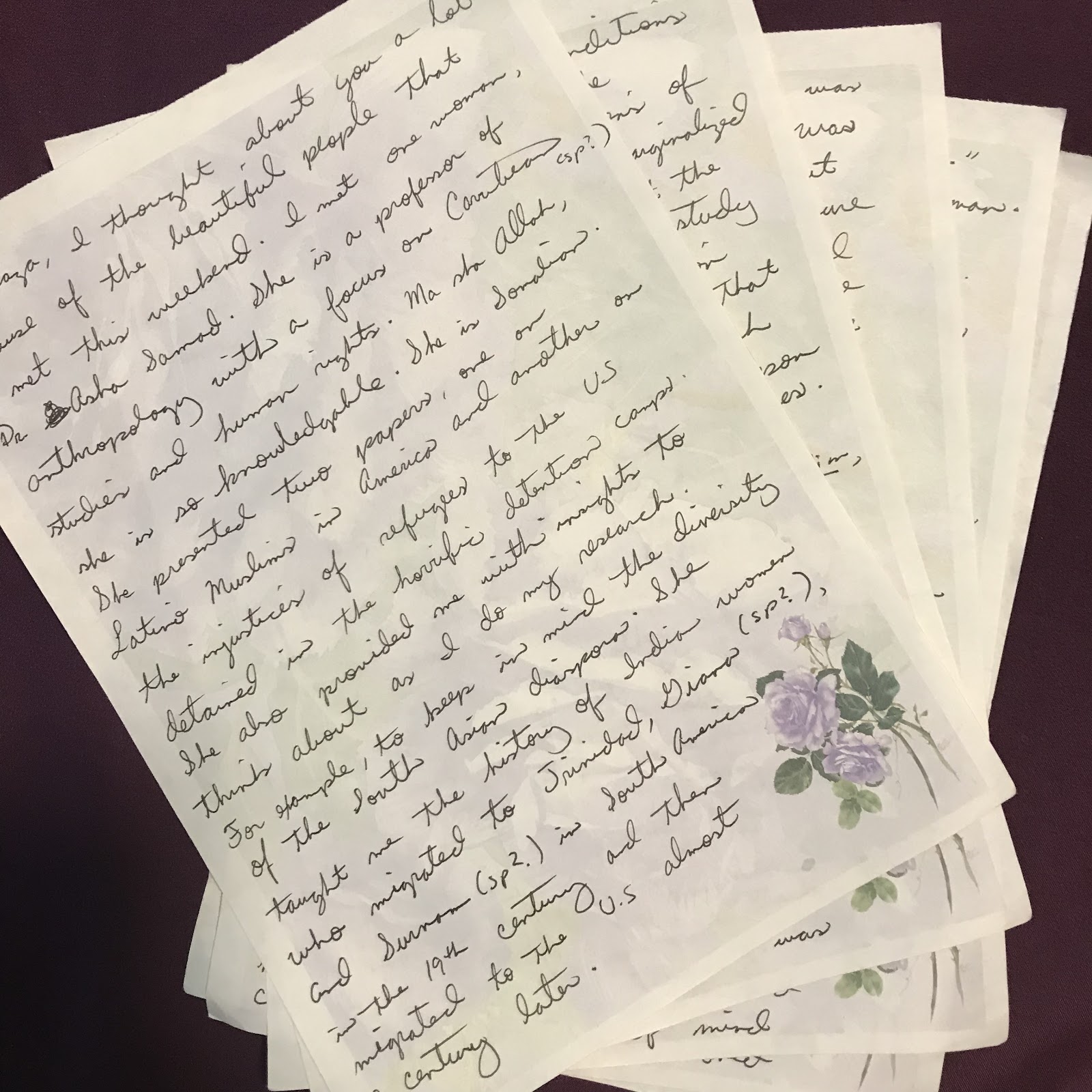
But then I found an old letter to her.

Love Note #1
July 3, 2001
. . .
I pray that this letter finds you in Allah’s mercy and love. I am writing this letter inspired to write to you and only you. I feel this way because I realize that God sent you as a companion for me on the path, and I did not always know it or appreciate it.

I don’t know where to begin. Allah (swt) is so Merciful, so Generous, and so Magnificent.

This letter was to a dear friend who introduced me to a program to sit with and learn from eminent scholars of our time. I told her about my Maliki fiqh class with Shaykh Hamza, and then wrote,

My heart and intellect want and desire so much. The knowledge quenches my thirst but only makes me thirsty again. Pray patience for me.


I was twenty-five then. And not married. Not surprisingly, the next paragraph in the letter describes my desire for marriage and a brother I had noticed. At the time, I had no idea that I’d have to wait another four years for that type of union.

Now back to the love I did possess. My love for this sister beloved was engraved on my heart, but the letter was long forgotten.

Fast forward fifteen years, two days before turning forty. I am married with three sons. I write a love note that mirrors the mingling of satisfaction and wanting expressed in love note #1. The days of pretty stationery now long gone, this time I confess my love in a text. (I’m giggling.)

This love note, #2, is also to a sister, inspired by this Amir Sulaiman line, “Let my breaking be beautiful.”

5/8/16
. . .
Your beauty is my breaking...My breaking deepens because in the vastness of pleasure, my heart discovers there is no limit to Allah’s Beauty and Love. I become immeasurably content only to find myself wanting more. Wanting Allah. May Allah give us Allah.
(Edited)


Satisfaction, desire, breaking, yearning, prayer, patience, love, Allah! I call these feelings and expressions—gently colliding--Radical Love.

Radical Love is love for the Divine manifested in passionate love for Allah’s creation,
Love with God written all over it,
Love heightened, elevated, and sweetened,
Love with the physical veils lifted and sensual satisfaction not the goal intended,
Love you hadn’t expected to find here or there
because you had yet to realize that love is everywhere.

What? You found love where?!
I began this post with mention of love for him because that is how women are expected to speak of love. And our ultimate breaking must relate to him, especially if he desires another her.

I’m sorry, beloved, this is not my love language or story.

True, he desired her,
Made union with her,
All of it pleasing and sacred,
A destined son, a delight,
Came out of it.  

For sure, I experienced heartbreak. But the wound is where the light enters. Rumi said it, but all of our hearts have lived it. 

Beloved, my story is that of Radical Love.

Yes, I experience it with him,
In love with him,
Caresses I’ve known only through him.

But, as love note #1 proves, I was on this path well before him--loving and longing and breaking.

Perhaps, though, there's a reason why Radical Love appeared to give birth with this particular breaking, that is, watching my romantic beloved love another beloved. I never expected to find so much love in it.   

Hopefully another love note will help to capture what I’m saying. Let’s call this love note #3:

October 12, 2017
I am reminded of the moment when I realized that love was the reward for Ihsan (virtues like beautiful patience and generosity). I mean really realized it, and I began to do so the moment when from the outside, it appeared that I had lost out on the pursuit of love as the world sees it. I was experiencing this unseen love, between God and me, which many people would expect, given that we turn to Allah in hardship. But what was mind-blowing was the human love that suddenly overflowed in my direction. That even I had not anticipated. In God’s mercy and loving kindness, He not only makes His Love tangible, but He gives His Love through actual people. And the best of people through whom He showers His love is His Beloved (S).

A Prayer for Hagar
And I wrote all of the above to provide context to a poem inspired by Hagar (R). But before the poem, there is Prophet Ibrahim's (S) prayer. I've read this prayer countless times before, but it wasn't until this time that it came to me, that his prayer embodied Radical Love, and I couldn't wait to share with you. And I had to before this sacred month left us. My way of saying, I love you.

Mother Hagar,
After drinking from your sacred bosom,
Walking your sacred struggle,
The pilgrims have left you,
Returning home,

But home is where the heart is,
We are still thinking of you,
Remembering you,

Every time we hear your story, we worry for you,
Who will feed you, sustain you?

Then we remember,

Prophet Ibrahim (S) left you,
But his first prayer was for you,
A man of heart,
Sustenance was the last thing he worried for you!

“Our Lord! Verily, I have settled some of my progeny in a valley without cultivation by Your Sacred House, our Lord, that they might perform the prayer. So cause the hearts of people to incline toward them, and provide them with fruits, that haply they may give thanks.”

Prophet Ibrahim’s prayer embodies Radical Love through and through,
Who would expect to find love where there is hardly life?
But Prophet Ibrahim knew,

Devotion to God was his first concern,
“That they might perform the prayer,”
Divine Love would spill over from the cup of devotion,
He knew.  

And how does Divine Love manifest here on earth? In human hearts--Prophet Ibrahim’s dua’ for his family--and then fruits. This is the prayer for true happiness, he knew.  

My First Radical Love Poem
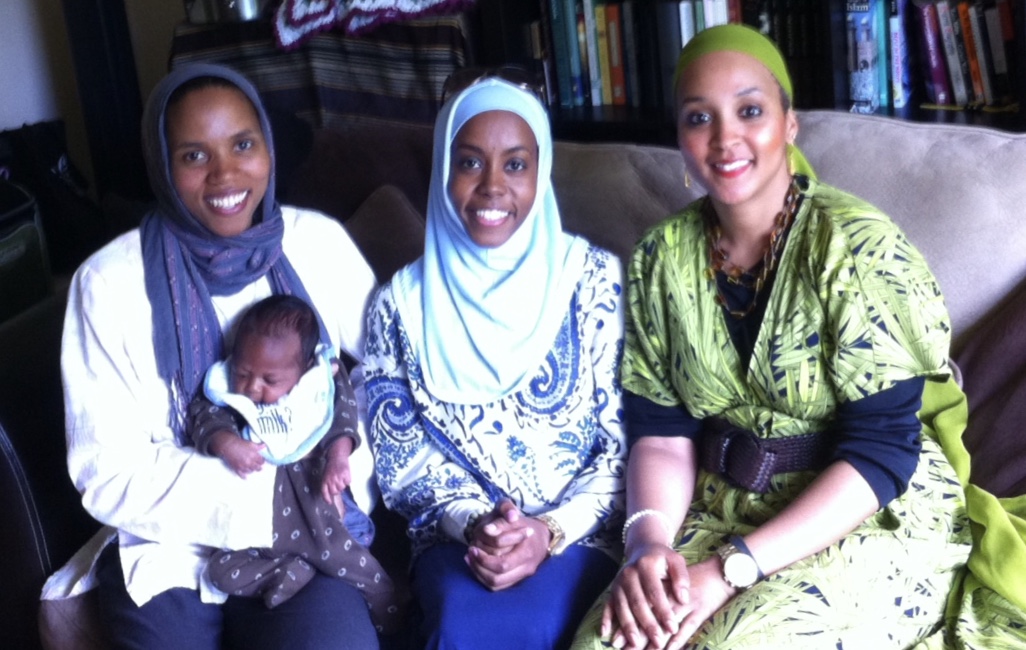
So now that I’ve explained Radical Love, it won’t surprise you that my first Radical Love poem is for her. In the embrace of a sister beloved, I remember Hagar.


May 2013, The year I prayed to be Hagar (Smile)

“Being with Hagar”

Fullness flowing everywhere,
My hand in her hand,
My slender arm wrapped in her fullness as her baby sucks the milk that Allah gave,

Our hearts occupied with the remembrance of Allah,
Our eyes on the Awliya’ Allah,
Our bodies at the house of Allah,

All other desires,
The remembrances of all other beloveds,
They stream down into this single gushing river,

This love came out of dying,
Out of intense longing,
It came when my heart was broken,
And I could only turn to God,

It came when I became Hajar,
Left in the desert with only God to fall on,


This love came like Zamzam,
Out of nowhere, making it utterly Divine,
It is the love that pilgrims drink from,
Pure because the source is Pure,

Allah is the Holy One,
Blessing this love,
Elevating this love,
Giving me life,
Turning me to Allah and His Beloved,

Through him, Sallalahu alayhi wasssalam,
Through the Beneficent King, the Holy One,
Through her, may Allah bestow peace on Hagar,
I have tasted the sweetness of Iman,
And have been led to the path of Ihsan,
Where I am living and dying,
For the Face of Allah.


April 2017, Goree Island, Senegal


*Please pray for me and my book tentatively titled, Radical Love: Sufi Reflections on Heartbreak and Happiness.